
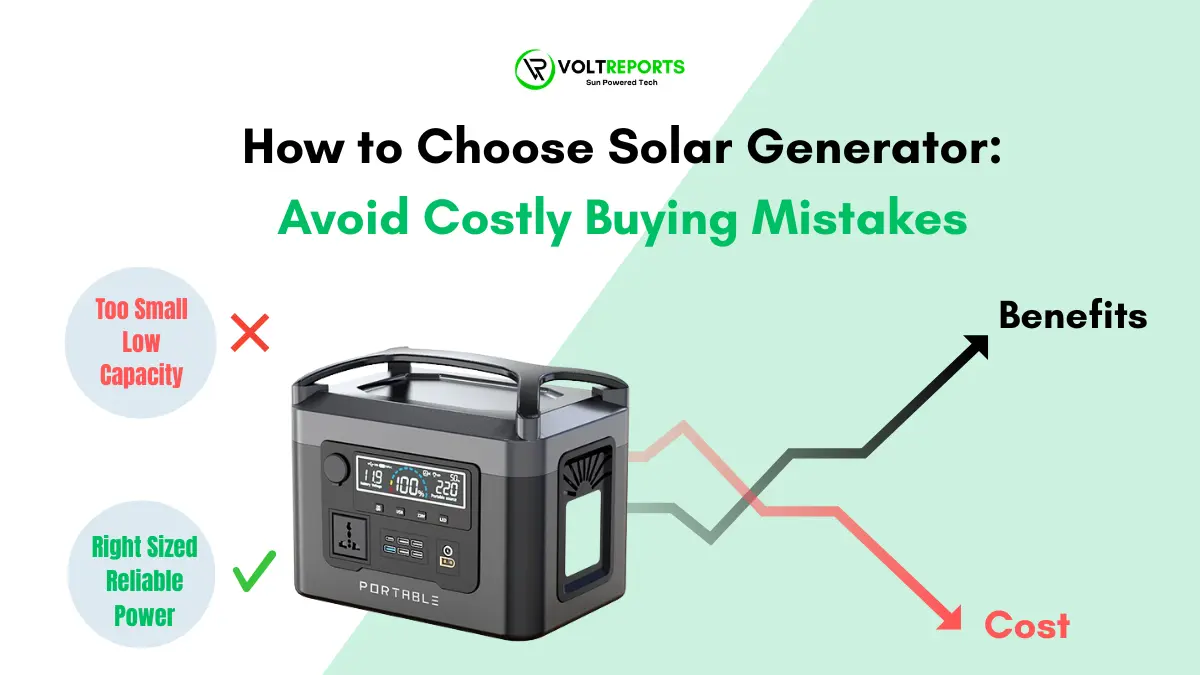
How to Choose Solar Generator: Avoid Costly Buying Mistakes
Investing in a portable power station is a game-changing decision for your energy independence. However, figuring out how to choose solar generator systems can feel overwhelming with so many brands and technical specifications on the market today. You want reliable off-grid power, but you also want to avoid spending thousands of dollars on a unit that fails to run your essential appliances.
This comprehensive solar generator buying guide will walk you through everything you need to know. We will break down confusing metrics like watt-hours, demystify battery capacity, and help you find the absolute best solar generator for camping, home backup, or RV life. By the end of this guide, you will have the exact knowledge required to make a confident and secure purchase.
1. Understand Your Power Requirements
The most critical step in buying a solar backup generator is knowing exactly how much electricity you need. Buying a generator that is too small leaves you in the dark, while buying one that is too large drains your wallet unnecessarily.
Running Watts vs Starting Watts
Before you look at solar generator reviews, you must understand the difference between running watts and starting watts.
Running watts refer to the continuous power an appliance needs to operate normally. For example, a standard LCD television might require 150 watts to stay on.
Starting watts, also known as surge watts, represent the sudden spike in energy required to turn on appliances with electrical motors. A refrigerator might only need 200 running watts to keep your food cold, but it could demand up to 1,200 starting watts when the compressor kicks on.
When evaluating a portable power station, you must check its continuous AC output and its peak surge output. If your generator has a continuous rating of 1,000W but a surge rating of only 1,200W, it will instantly shut down if your refrigerator demands 1,500W at startup.
Calculating Daily Energy Needs
To determine your exact solar power station size guide, you need to perform a basic energy audit. Grab a piece of paper and list every device you plan to power during an outage or a camping trip.
Next to each device, write down its running wattage. Then, estimate how many hours per day you plan to run that specific item. Multiply the wattage by the hours of use to find the daily watt-hour requirement.
For instance, running a 60W CPAP machine for 8 hours equals 480 watt-hours. Running a 10W smartphone charger for 2 hours equals 20 watt-hours. Add all your daily watt-hours together, and you will have a clear baseline for the battery capacity you need to purchase.
Appliance Wattage Examples
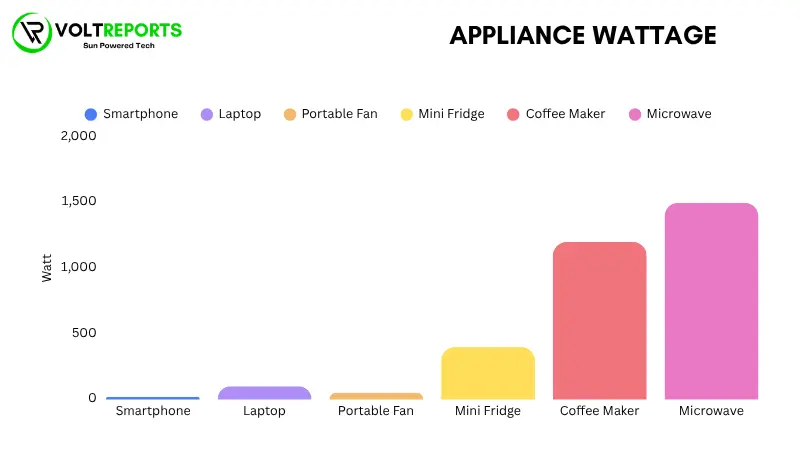
To make your math easier, here are some common appliances and their estimated power demands. Always check the manufacturer label on your specific device for the most accurate numbers.
- Smartphone Charger: 10 to 20 watts
- Laptop Charger: 60 to 100 watts
- LED Light Bulb: 10 to 15 watts
- CPAP Machine: 40 to 80 watts
- Portable Fan: 30 to 50 watts
- Mini Fridge: 100 running watts, up to 400 starting watts
- Full-Size Refrigerator: 200 running watts, up to 1,200 starting watts
- Coffee Maker: 800 to 1,200 watts
- Microwave: 1,000 to 1,500 watts
For more buying advice, visit our best solar product reviews and comparisons.
Generator Sizing Mistakes
One of the most frequent errors buyers make is ignoring inverter efficiency. Most solar generators lose roughly 15% to 20% of their stored power during the conversion from DC battery power to AC wall power.
If you buy a 1,000Wh battery capacity generator, you will practically only get about 800Wh to 850Wh of usable power for your AC appliances. Always factor in this efficiency loss. A great expert tip is to calculate your total daily energy needs and then multiply that number by 1.25 to ensure you have an adequate safety buffer.
2. Battery Capacity and Battery Type
The battery is the beating heart of your emergency power supply. Understanding the chemistry and capacity of that battery will determine how long your devices stay powered and how many years the generator will last.
Watt-hours Explained
Watt-hours dictate the total volume of energy your solar generator can store. Think of the inverter output (watts) as the speed of your car, and the battery capacity (watt-hours) as the size of your gas tank.
A 500Wh battery can run a 100W device for approximately 5 hours under perfect conditions. In reality, accounting for inverter losses, it will run that device for roughly 4 hours. When you browse the market, you will notice that the price of a unit heavily correlates with its watt-hour rating.
LiFePO4 vs Lithium-Ion
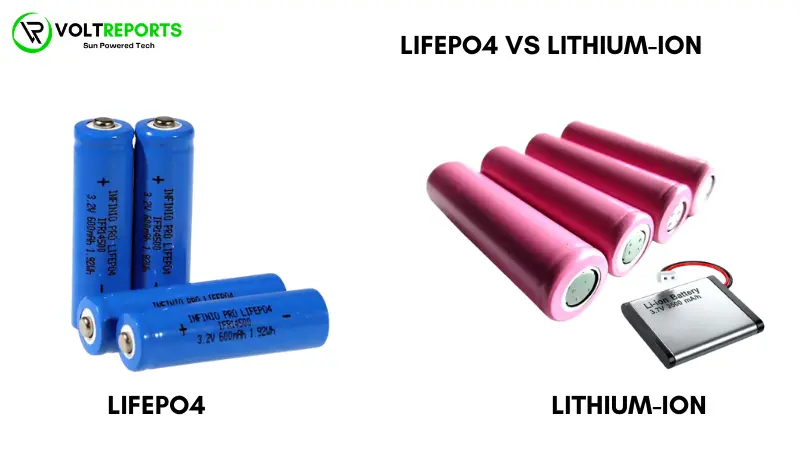
The internal battery chemistry is a massive factor in 2026. You will primarily see two types of batteries: standard Lithium-Ion and LiFePO4.
Standard Lithium-Ion batteries are incredibly lightweight and compact. They are fantastic if portability is your absolute highest priority. However, they degrade much faster over time and are more sensitive to extreme temperatures.
LiFePO4 batteries are the modern gold standard for solar generators. These batteries are incredibly safe, highly resistant to thermal runaway, and boast exceptional longevity. The only disadvantage is that LiFePO4 batteries are noticeably heavier than standard lithium batteries. If you are building an off-grid power system for your home, the extra weight is completely worth the massive upgrade in lifespan.
Battery Lifespan
Lifespan is the silent cost factor in any solar generator buying guide. A cheaper portable power station with a standard lithium battery might only last a few years under heavy daily use. A premium unit with a LiFePO4 battery will easily last over a decade.
When you invest in an emergency power supply, you want peace of mind knowing the battery will hold a charge five or ten years from now. This is why experts universally recommend prioritizing modern battery chemistry over minor cost savings upfront.
Charge Cycles
Manufacturers rate battery lifespan in charge cycles. One charge cycle equals draining the battery completely and charging it back to full.
Traditional lithium batteries usually offer 500 to 800 charge cycles before their maximum capacity drops below 80%. If you use the generator every single day, it will degrade noticeably in about two years.
LiFePO4 battery technology changes the game entirely. These cells routinely offer 3,000 to 6,000 charge cycles. You could deplete and recharge a LiFePO4 generator every single day for ten years, and it would still hold over 80% of its original factory charge.
Runtime Calculations
To figure out exactly how long a specific power station will run your gear, use a simple formula. Take the total battery capacity in watt-hours, multiply it by 0.85 to account for inverter efficiency loss, and divide that number by the wattage of your device.
If you have a 2,000Wh generator and want to run a 60W portable fridge, the math looks like this: 2000 times 0.85 equals 1700. Divide 1700 by 60, and you get 28.3 hours of runtime.
3. Charging Options and Solar Compatibility
A battery is useless once it runs empty. How fast and effectively you can put energy back into your portable power station is just as important as how much it holds.
Wall Charging
AC wall charging is the fastest and most common way to juice up your unit before a storm hits. Modern generators feature fast-charging technology that can push a battery from zero to full in under two hours.
If you are prepping for a hurricane, fast wall charging is a massive advantage. You can plug the unit in right when you hear the weather alert and have a fully topped-off battery before the grid goes down.
Solar Charging
Solar charging is what transforms a standard battery box into a true solar generator. By connecting photovoltaic panels, you can harvest unlimited free energy from the sun.
When reviewing specifications, pay very close attention to the maximum solar input rating. A generator with a massive 2,000Wh battery but a tiny 200W solar input limit will take a grueling 10 hours of perfect, direct sunlight to recharge. Look for units that accept 500W or more of solar input for faster off-grid recovery.
Vehicle Charging
Vehicle charging allows you to plug the generator directly into the 12V cigarette lighter port in your car or truck. This is an essential feature for overlanders and road trippers.
The disadvantage of vehicle charging is speed. A standard 12V port only delivers about 100 watts to 120 watts of power. It can take an entire day of driving to recharge a large home backup unit, but it is perfect for keeping small devices topped off during a road trip.
MPPT Technology
Maximum Power Point Tracking is a critical feature you must look for. An MPPT charge controller is the internal brain that manages the incoming power from your solar panels.
Solar panels do not output a steady stream of electricity. A cloud passing by or a change in the sun angle alters the voltage. An MPPT controller dynamically adjusts to these fluctuations to pull the maximum possible wattage from the panels at all times. Generators with MPPT controllers charge up to 30% faster than older units using cheap PWM controllers.
Solar Panel Compatibility
Not all solar panels work with all generators. You have two main routes to choose from. You can buy proprietary panels from the generator manufacturer, which guarantees an easy, plug-and-play experience. Alternatively, you can use third-party rigid or flexible panels.
If you choose third-party panels, you must ensure the open-circuit voltage of the panels does not exceed the maximum voltage limit of the generator. Plugging in panels with voltage that is too high will permanently destroy the internal MPPT controller.
4. Choosing the Best Solar Generator for Your Use Case
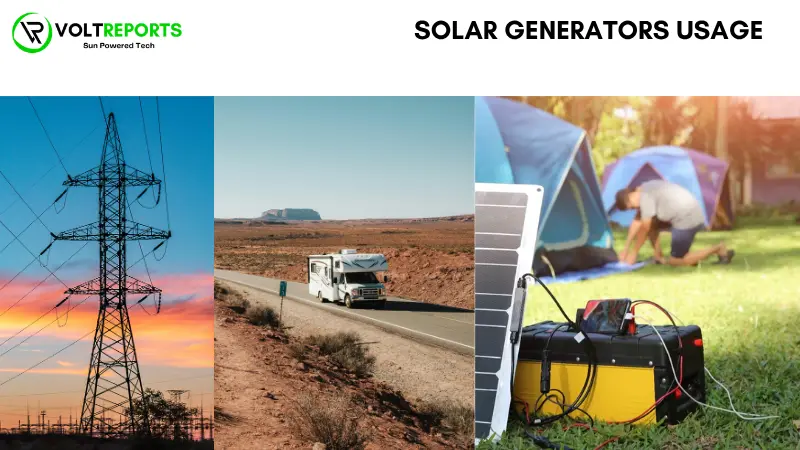
The ideal solar power station size guide ultimately depends on your specific lifestyle. Let us break down the perfect setups for the most common scenarios.
Camping
The best solar generator for camping needs to be lightweight, rugged, and highly portable. You are likely only charging smartphones, drones, camera batteries, and maybe a small string of camp lights.
A unit in the 250Wh to 500Wh range is absolutely perfect here. It will weigh under 10 pounds, making it easy to carry from your trunk to the picnic table. Pair it with a compact 100W folding solar panel, and you will have infinite power for a weekend in the woods.
RV Travel
RV owners demand significantly more power. You are powering 12V refrigerators, water pumps, ventilation fans, and possibly a microwave or coffee maker.
For RV travel, look for a generator in the 1,500Wh to 2,000Wh range. It is crucial to find a unit equipped with a dedicated 30-amp RV plug. This allows you to plug your entire rig directly into the generator, powering all your wall outlets instantly without running messy extension cords everywhere.
Home Backup
When the grid fails, a home backup system must step up to keep your essential appliances running. You will need to power full-size refrigerators, internet routers, lights, and medical devices.
Emergency Preparedness
For general emergency preparedness in apartments or small homes, a mid-sized 1,000Wh generator is the sweet spot. It provides enough capacity to run a fridge for several hours to save your groceries, while easily keeping emergency radios and phones charged for a week.
A 1,000Wh unit is also light enough to easily throw in the back of your car if you need to evacuate your home quickly.
Off-Grid Living
Off-grid living requires massive power reserves and incredibly fast solar charging speeds. You are entirely replacing the utility company with your own equipment.
For a true off-grid cabin, you need high-capacity modular systems capable of producing 240V split-phase power. You will need units that offer 4,000W to 7,200W of continuous output and the ability to scale up to 10,000Wh or more of battery storage. You will also need a massive solar array, so ensure the generator can accept at least 1,500W of solar input.
5. Comparison Table
Here is a quick reference guide to help you categorize different generator sizes based on your needs.
| Category | Battery Capacity | Best Use Case | Typical Weight |
| Compact | 200Wh to 500Wh | Weekend camping, phone charging | 5 to 15 lbs |
| Mid-Size | 500Wh to 1,200Wh | Tailgating, short outages, CPAP | 15 to 30 lbs |
| Large | 1,500Wh to 2,500Wh | RV travel, essential home backup | 40 to 60 lbs |
| Expandable | 3,000Wh and up | Whole house backup, off-grid cabins | 80+ lbs |
FAQs: How to Choose Solar Generator
What size solar generator do I need to run a refrigerator?
To safely run a full-size household refrigerator, you need a generator with a minimum continuous output of 1,000W and a surge output of 2,000W. For battery capacity, aim for at least 1,500Wh to keep the fridge running overnight when the sun is not charging your panels.
Can a solar generator run a whole house?
Yes, but it requires a premium, expandable system. To run an entire home, including 240V appliances like well pumps or electric dryers, you need large scalable units wired directly into your home circuit breaker panel through a manual transfer switch.
How long do portable power stations hold their charge in storage?
Standard lithium batteries lose their charge relatively quickly and should be topped off every 3 months. Modern LiFePO4 batteries retain their charge much better, often holding power for 6 to 12 months in storage. Always store your generator in a cool, dry place.
Is it okay to leave a solar generator plugged in all the time?
It depends on the manufacturer. Many high-end brands feature internal Battery Management Systems that prevent overcharging and allow the unit to serve as an Uninterruptible Power Supply. Always read your specific owner manual before leaving a unit permanently connected to the wall.
Can I use different brand solar panels with my generator?
Yes, you can mix and match brands. You just need to purchase the correct adapter cable, usually an MC4 to XT60 or MC4 to DC7909 adapter. You must also ensure the combined voltage of your solar panels does not exceed the maximum input voltage rating of the generator.
Understanding how to choose solar generator models based on your power needs, battery capacity, and intended use will help you make a smarter and more cost-effective purchase.
Key Takeaways
- Always calculate your running and starting watts before making a purchase to avoid overloading your inverter.
- Factor in a 15% efficiency loss when estimating how long a battery will run your appliances.
- Prioritize LiFePO4 battery chemistry for maximum lifespan and long-term financial value.
- Ensure your chosen unit has an MPPT charge controller to guarantee fast and efficient solar charging.
- Match the generator capacity to your specific lifestyle. A massive 4,000Wh unit is terrible for a tent camper, just as a 300Wh unit is useless for a home power outage.
Conclusion
Figuring out how to choose solar generator equipment comes down to doing the math on your specific energy needs. By accurately calculating your daily watt-hour usage, understanding the massive benefits of LiFePO4 battery technology, and matching the unit perfectly to your lifestyle, you guarantee a flawless off-grid experience.
For more solar ideas, tips, and updates, follow us on Pinterest and Reddit.
Whether you are seeking the best solar generator for camping under the stars or a robust emergency power supply to protect your family during winter storms, the right portable power station will provide you with silent, clean, and reliable energy for decades to come. Take your time, compare the specifications, and invest in a system that truly aligns with your off-grid goals.